
Tanderrum is a Kulin ceremony for coming together. As a diplomatic rite, it was used to grant safe passage and offer access to resources.
With place as its foundation, Tanderrum uses relationship and negotiation to take carriage of and safeguard Indigenous engagement.
Drawing on Tanderrum as the philosophical foundation for our work, we use place, relationships and futures as our driving themes for advancing Indigenous peoples’ participation and achievement in health-focused higher education and leadership.
In our work we recognise the complexities of place that influence Indigenous people’s professional and academic success, the value of strong networks and relationships, and the importance of building and supporting Indigenous intellectual inquiry for healthy futures.
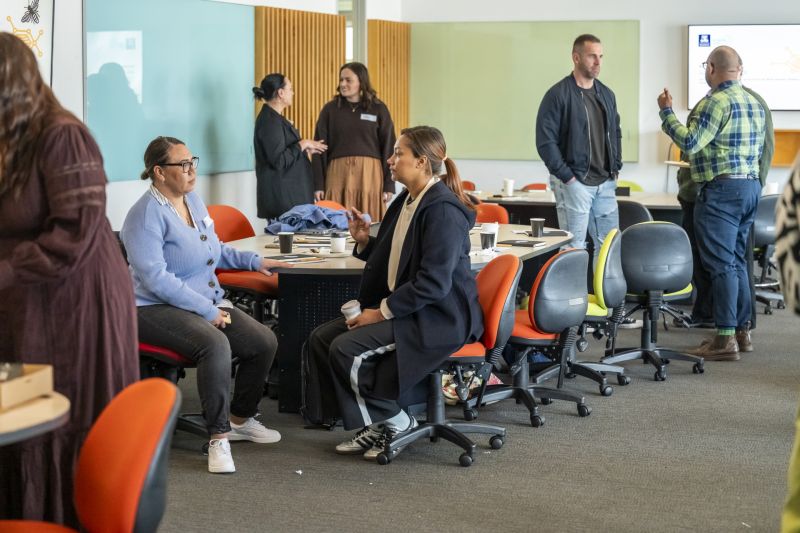
Place, relationships and futures
Our themes inform how we implement our strategic objectives and goals, ensuring and advancing Indigenous peoples’ achievement in higher education and leadership in health.
Indigenous philosophies of place represent significant epistemological and ontological departures from those that have emerged from Western understandings.1
An Indigenous ontology of place prioritises and centres the connectedness between place and its collective constituents that include humans, animals, the natural world – both living and non-living – and the spiritual world. Indigenous peoples emerge from place and actively draw on the power of place, both physically and spiritually — to be Indigenous means to be ‘of place’.
We draw on the power of place in our work, giving both ourselves and our stakeholders permission to be in place and culture while in the academy.
1. Tuck, E. & McKenzie, M. (2014). Place in research: Theory, methodology, and methods. Routledge.
Relationships ‘are the spiritual and cultural foundations of Indigenous peoples’.2
Relationality refers to connectedness, a view of the world that underlines how no person or thing exists in isolation, because existence necessarily means being ‘in relationship’.
As a practice of responsibility to kin, our work privileges Indigenous relationality and its prescribed protocols.
2. Alfred, Taiaiake, and Jeff Corntassel. “Politics of identity – IX: Being Indigenous: Resurgences against Contemporary Colonialism.” Government and Opposition, vol. 40, no. 4, 2005, pp. 597–614. JSTOR, jstor.org/stable/44483133
Often referred to as time that is to come, future is a temporal element that, along with present and past, relates to the linear progression of time and spatial position.
Distinctly different is the Indigenous concept of futures which are defined using an Indigenous worldview. Indigenous futures refer to horizons of insight that support prosperous communities, they are references to ‘felt’ time that are multidimensional, circular and relationally positioned.3
We use an Indigenous concept of futures in our work to support Indigenous horizons and flourishing communities.
3. Janca, A. & Bullen, C. (2003). The Aboriginal concept of time and its mental health implications. Australasian Psychiatry, 11(1), S40–S44.
Featured content
-
Towards 2030
How our philosophy and themes translate into two strategic objectives and six areas of impact
-
About the Centre
The centres founding, our people, and the networks we work within
-
Our work
The PhD Familiarisation, Graduate Research and Health Leadership programs, and Research, where the themes are put into practice.